
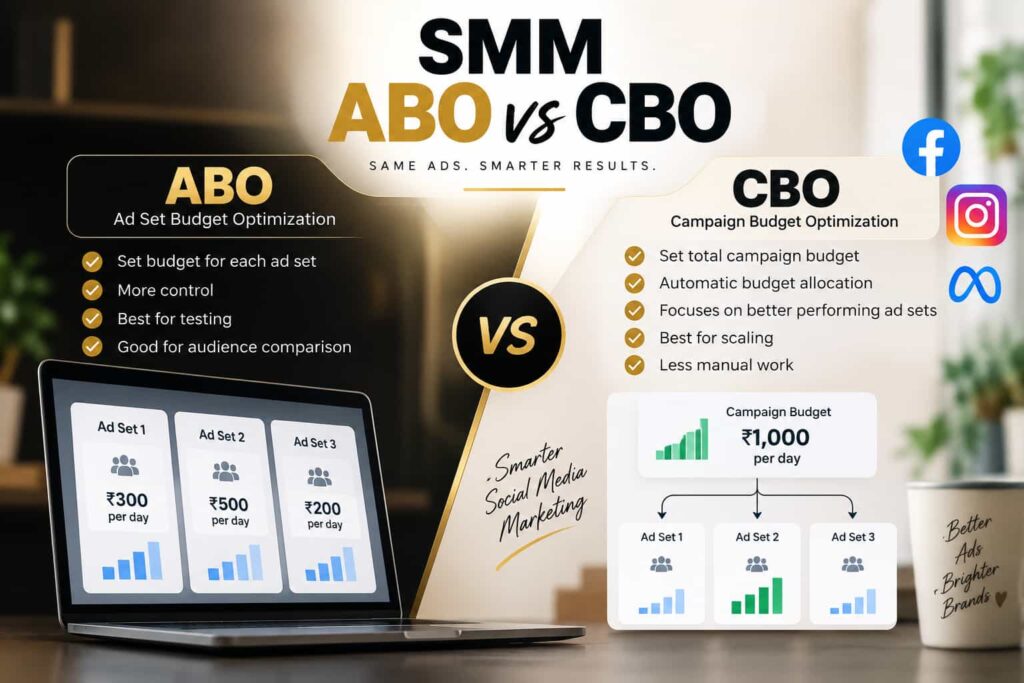
Difference between SMM ABO and CBO – Which One to Choose?
If you run SMM campaigns like Facebook and Instagram ads, there are two popular campaign budget options that you might know, ABO (Ad Set Budget Optimization) and CBO (Campaign Budget Optimization).
So, which one is better?
There is no answer that “ABO is better” or “CBO is better”. It really depends on your campaign objective, your audience, budget and level of control you would like to maintain over your ad sets. Having an understanding of the difference between them will let you utilize your advertising budget effectively.
What is ABO in SMM?
ABO refers to Ad Set Budget Optimization. In this case, you set budget for each of your ad set separately.
For instance, when you target three different audiences, you have the option to give different budgets for each audience separately.
Example:
- Ad Set 1 – ₹300/day
- Ad Set 2 – ₹500/day
- Ad Set 3 – ₹200/day
In this case, you can control the budget of each of your ad sets.
Advantages of ABO
ABO would help in situations where you wish to test different groups of people and have some budget-related issues.
- ABO offers better control over your ad sets
- ABO is helpful in audience testing
- Easier allocation of budget
- Ensures spending on each and every chosen audience
- Testing for new campaigns and creatives
For instance, when you wish to see the difference between Malappuram audience and Kozhikode audience, you could use ABO to allocate budget differently.
What is CBO in SMM?
CBO refers to Campaign Budget Optimization. Instead of manually allocating budgets to all ad sets, you can allocate a total budget to the whole campaign.
Then, the advertising platform will allocate your budget among your ad sets, depending on where it sees better performance.
Example:
If the total campaign budget is ₹1,000/day, and you have three ad sets,
Instead of manually allocating ₹300, ₹400, ₹300 to the respective ad sets, you just give the total campaign budget as ₹1,000.
In such a case, the platform will allocate more budget to an ad set where it sees good performance.
Advantages of CBO
- Budget distribution in an automated way
- Can be useful for focusing on the ad set that performs well
- No need for frequent budget allocation by hand
- Helpful when you have different audiences
- Good for scaling campaigns once you find out the right audiences
Key Differences between ABO and CBO
Major difference is that of budget control.
ABO
- Budget is controlled on the ad-set level
- Highly manual budget control
- Good for audience targeting tests
- Easy to ensure spending on specified ad sets
CBO
- Budget is controlled on the campaign level
- Automated budget control
- Good for scaling
- System can allocate resources on better performing ad sets
Which One Should You Choose?
There is no one-size-fits-all answer. You need to consider your current stage of the campaign and its goals.
Use ABO in case:
- You are testing several audiences.
- You require equality or certain distribution of your budget between ads.
- You need more control over your budget.
- You compare the performance of your audiences.
- You are experimenting with the campaign at the very beginning.
Use CBO in case:
- You have valuable performance statistics.
- You need automatic distribution of your budget.
- You try to scale a successful campaign.
- You have several ad sets and want to automate the optimization of the spending.
- You don’t want to manage your budget manually.
A Smart Approach for Novices
If you are a beginner in SMM marketing advertising, a wise approach will be to use ABO in order to test first.
Test different:
- Audiences
- Creatives of your ads
- Your offers
- Placements
- Messages of the campaign
When you identify those audiences and creatives that bring good results, you may think about CBO scaling.
Conclusion
ABO and CBO do not compete against each other; in some cases, one may be better, while in others – the other one will give you more results. These are simply two different ways to manage your advertising budget.
ABO offers you more flexibility in terms of budget management and it makes it more suitable for experimenting. In CBO you give more control to the platform itself when it comes to budget distribution; it will work fine when you have several ad sets in your campaign and wish to optimize and scale it based on its performance.
The most intelligent approach to SMM would be to define your campaign goal first, experiment with your options, pay attention to important metrics, and then select a budget structure depending on your campaign.